God is Love
 The book of John, the most theological of all four gospels. Out of this book we get the most famous Bible verse of all time. You see it painted on the faces or giant stomachs of football fans, you see it tattooed on the bodies of reformed tough guys, or you hear it quoted by misleading politicians clamoring for the Christian vote, it's John 3:16 "For God so loved the world, that he gave his only Son, that whoever believes in him should not perish but have eternal life." It is this love that is the theme of John and it is poured out in every chapter. It is this love that gives the Christus Victor view of the atonement major ground to stand on. That the death and resurrection of Jesus was not a business transaction between two parties, but a selfless, covenantial fulfilling of God's promise to redeem us. This love, that was in the beginning with God and was God, became flesh, yet still fully God, wrapped in humility to reconcile us back to the Father. Other than the resurrection, with questions that I've asked before in other blog posts, is that not the largest miracle God has ever preformed? Does that not show the depths of His love?
Simple Words
Let me start with a rant. I can't tell you how many times I've read online comments that people who practice Christianity are reading an old, out-dated, rule-book given them by a magic sky-faerie. While it is sometimes an amusing comment, it's also frustrating because people like that have a very superficial view on Biblical scripture. Pastor Bruxey Cavey put it like in his "End of Religion" sermon series, "you can't just jump into the middle of a book, start reading and expect to get the whole picture." He continues, and I'm paraphrasing here, "throughout the whole bible, God consistently meets us where we are to teach us truths." It's surface issues like the former, where people just open the Bible and point out something they think is ridiculous, but miss a deeper message.
 My point is, if you judge something solely at face value you're going to miss out on a potential life changing experience. In this case, the same could said for judging the simple words in this gospel. John didn't use sophisticated words while writing his gospel, he used words like "Word", light, flesh, love and so on. The original Greek he wrote is also considered by scholars to be "baby Greek," but so what? In our westernized culture we have a tendency to think that only large sophisticated words will be able to properly display complexity. Yet through the choice words, teachings, and events we are carried along on a wave of spiritual activity, thereby dumping the argument on its head.
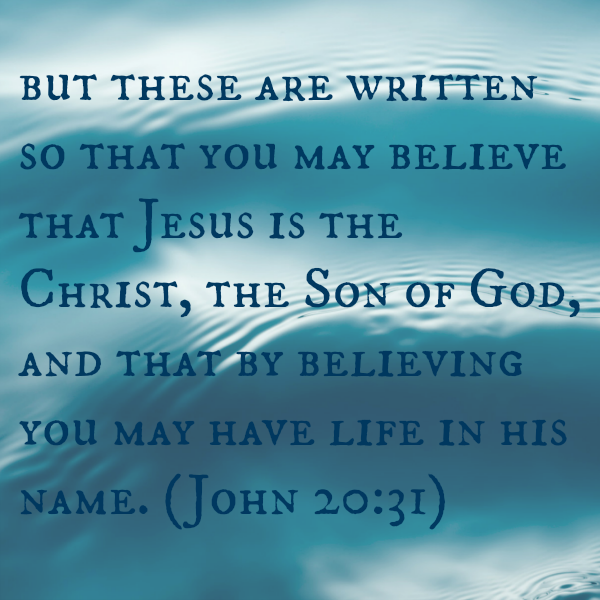
One other word that is a centralized theme in John is "belief," or "believe." In fact the word is so important to John that he uses the word it 98 times throughout this particular book, the whole purpose of this gospel could be argued that it hinges on chapter 20 verse 31, pictured above. The last thing I'll point out is the use of the Logos doctrine, it has both Hebrew and Greek connections. As we see throughout the gospels each one has a specific audience it's trying to reach, this particular gospel is for new Christians, and people searching. At the time the world was very Hellenistic, meaning inspired by Greek culture and philosophy. There were also Jewish Christians, or people that converted from mainstream Judaism who accepted Jesus as their savior. The Greeks determined that their was a divine reason for order and purpose in creation and they called it the Logos principle. For the Jewish culture, the "Word" illustrated the self expression of God. For both of these cultures "Logos" is the beginning of all things and John appealed to these philosophies to grab the attention of the reader during his day.
The Divinity of Christ
In my high school photography class most of our homework assignments were just to take pictures of anything we wanted. I remember one of my classmates took a photo of a stain-glass window at the catholic church he attended with his family. We started talking about God and I must have said something to upset him because he snapped at me, "Jesus never claimed to be God in the Bible!" This is another argument I often hear and I don't blame the kid for saying it because the language of scripture is different from our common day English. Nevertheless, Jesus did claim he is the Messiah, especially while talking to the Samaritan woman in John 4:26. Also, look at this verse Jesus spoke while at the temple, " Jesus answered, “I tell you the truth, before Abraham was even born, I am!" (John 8:58 NLT). When the religious leaders heard him say that, they freaked out and grabbed the nearest rock to throw at him. That's not a statement a person could make in his day and get away with it. The phrase "I AM" was/is considered to the Jewish culture a holy name of God, and Jesus applied it to himself, which unmistakeably declared his divinity. Specifically, so that we may believe in Christ, John used seven more examples of Jesus stating his divinity and they are commonly known as the "I am's." Example, "Jesus spoke to the people once more and said, “I am the light of the world. If you follow me, you won’t have to walk in darkness, because you will have the light that leads to life” (John 8:12). If that weren't enough John used seven signs (miracles) to prove the Jesus is the Messiah, such as the raising of Lazarus from the dead. Raising Lazarus from death is significant because death is the single greatest threat to human existence and this miracle shows that Jesus was not limited by deaths hold on us.
The Compassion of Jesus and God in the temporal realm

Just because Christ was not limited by death, as we see in this book with the whole Lazarus thing and in the other gospels with the resurrection, it doesn't meant he is indifferent to our suffering. Have you ever had a family member or perhaps a close friend in intense emotional pain due to a loss of someone important to them? They are pretty much inconsolable and no matter what you do, what words you say, you just can't seem to take away their pain. Then perhaps, they're so emotional, so distressed, that you yourself begin to cry because their pain moves you. Such was the case the Mary and Martha, the sisters of Lazarus, no matter what words Jesus said to the sisters, their grief and the grief of those around them moved him to tears. He cares enough to weep along with us in our suffering. The difference between Jesus and us is his divinity, he is God. Jesus was able to enter the tomb of a dead man and bring him back to the living, turning grief into joy. It might not be something as miraculous as that these days, but if we let God in we do have the ability to be restored.
For the last 50 years or so there's a big hullabaloo going on in the world of theology about God and whether or not He exists in time and space. One argument suggests that if He did exist in time and space than he would be constrained by the effects of time, thereby limiting his power. I ask, why would the creator of time be a slave to His own creation? If He was afraid of time than we wouldn't even have a belief in God because He wouldn't interact with beings that operated within a linear time-stream. He most likely isn't afraid, or limited and throughout the Bible we see that he cares about our time here on earth and moves within the temporal realm because of His compassion for us. One more way we are shown this is when Jesus prays for future believers in the Garden of Gethsemane, "20 My prayer is not for them[disciples] alone. I pray also for those who will believe in me through their message, 21 that all of them may be one, Father, just as you are in me and I am in you. May they also be in us so that the world may believe that you have sent me" (John 17:20-21).
Far From the End
There are lots of things I could still cover and there is a possible conclusion I could come to for this book, but I choose not to. In truth John's words don't really end here because they stretch into eternity with the book of Revelation where God completes his promise. For those of you who have followed me on this journey of covering this gospesl I want to thank you. If you're are a believer, please remember Jesus' command, "Feed my lambs" (John 21:15). If you are searching, I hope my writings have at least made you think.
References
"Does God Dwell Within or Outside of Time?" A Question Is Asked. UK Apologetics, Web. 15 Aug. 2014.
Flora, Wayne. "The Gospel of John." New Testament Survey. Online, Cleveland. 15 Aug. 2014. Reading.
Life Application New Living Translation, Study Bible, Tyndale House Pub, 2012. Print.
Tenney, Merrill C., Walter M. Dunnett, and Merrill C. Tenney. New Testament Survey, Revised. Grand Rapids, MI: Wm. B. Eerdmans Pub., 1985. Print.


